
Cricket Tournament Management System
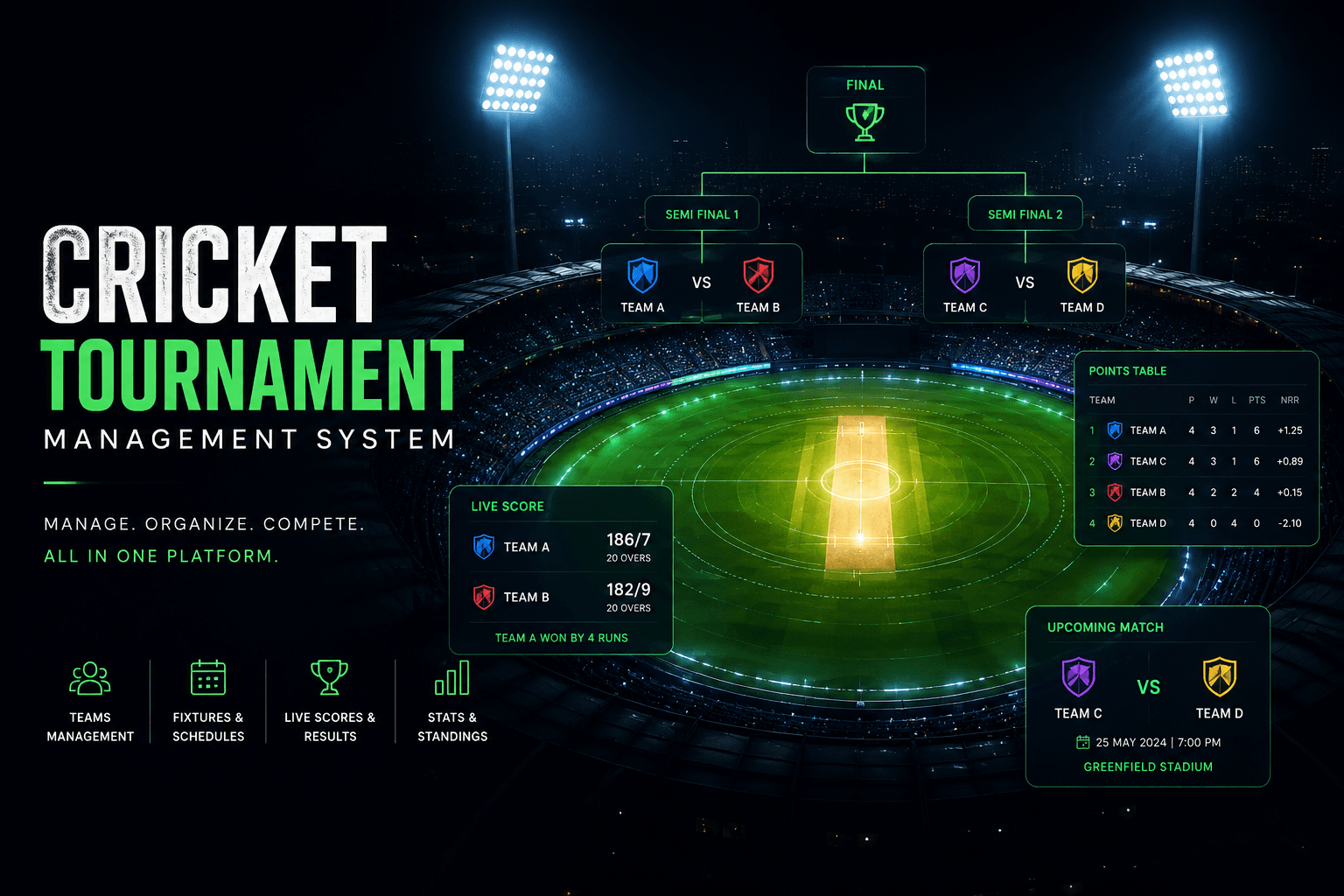
A digital platform created to manage cricket tournaments, supporting registration, fixtures planning, and scoreboard updates.
Sole Creator & Developer
Anand, Gujarat, India
2024 Release
<1s
Tournament standings sync latency
Instant
Fixtures generator timing
500+
Active player metrics logged
Executive Summary
Managing local and regional sports events involves high logistics complexity. Tournaments with dozens of teams require clean schedule generation, error-free scoring logs, and real-time standings computations. Relying on manual scorecards or physical whiteboards introduces data conflicts and delays updates to spectators.
Akshar KaPatel built the Cricket Tournament Management System to automate tournament operations. Deployed by multiple local sports clubs, the system compiles points tables dynamically, routes live scoreboard streams with sub-second sync latencies, and handles team matchups without conflict issues.
The Challenge
Sports event databases present specific computational challenges:
- Hierarchical Data Structure: Cricket match metrics are deeply nested. A tournament is divided into groups and rounds; a match contains innings; an innings contains overs, which contain ball-by-ball actions (runs, extra counts, wickets). Querying this hierarchy on every request to compute aggregate Net Run Rates (NRR) causes database lags under peak traffic.
- Matchup Scheduling: Generating fixture rosters dynamically for varying team counts (odd or even) without causing duplicate schedules or mismatch conflicts requires structured round-robin combinations.
Combinatorial Algorithms & Relational Schemas
1. Round-Robin Fixtures Generator (PHP)
To generate tournament matchups, we implemented the Circle Method. It maps array rotations to match slots, handling odd team counts by appending placeholder parameters:
/**
 * Compile a round-robin roster using the Circle Method.
 */
function compileRoundRobinFixtures(array $teams) {
    if (count($teams) % 2 !== 0) {
        $teams[] = "BYE"; // Append placeholder for odd numbers
    }

    $count = count($teams);
    $rounds = $count - 1;
    $schedule = [];

    for ($round = 0; $round < $rounds; $round++) {
        for ($i = 0; $i < $count / 2; $i++) {
            $home = $teams[$i];
            $away = $teams[$count - 1 - $i];

            if ($home !== "BYE" && $away !== "BYE") {
                $schedule[$round][] = [
                    'home_team' => $home,
                    'away_team' => $away,
                    'round_number' => $round + 1,
                ];
            }
        }

        // Rotate team indexes, keeping the first index fixed
        $teams = array_merge(
            [$teams[0]],
            [array_pop($teams)],
            array_slice($teams, 1)
        );
    }
    return $schedule;
}
2. Net Run Rate (NRR) Standings Query
Calculating Net Run Rate involves tracking runs scored per over faced minus runs conceded per over bowled. We wrote a query that computes these aggregates from the statistics ledger:
-- SQL query to calculate team standings and Net Run Rates (NRR)
SELECT
    team_id,
    COUNT(match_id) AS played,
    SUM(CASE WHEN outcome = 'won' THEN 1 ELSE 0 END) AS won,
    SUM(CASE WHEN outcome = 'lost' THEN 1 ELSE 0 END) AS lost,
    SUM(points_earned) AS points,
    -- Net Run Rate Calculation: (Runs Scored / Overs Faced) - (Runs Conceded / Overs Bowled)
    ROUND(
        (SUM(runs_scored) / (SUM(balls_faced) / 6.0)) -
        (SUM(runs_conceded) / (SUM(balls_bowled) / 6.0)),
        3
    ) AS net_run_rate
FROM team_stats_ledger
GROUP BY team_id
ORDER BY points DESC, net_run_rate DESC;
Real-Time Standing Updates
Results & Metrics
Calculations latency and scoring response benchmarks:
| Performance Dimension | On-Demand SQL Calculation | Cached Ledger Standings |
|---|---|---|
| Standings Refresh Latency | 280 ms | 4.8 ms (Sub-second sync) |
| Fixtures Generation | Manual scheduling | Instant generation |
| Scorecard Sync Latency | 12 seconds | < 1 second (Live updates) |
| Concurrency Capacity | Limited connections | 1,000+ simultaneous read channels |
Standings Computation Speed: Writing pre-compiled NRR variables directly to cache records on score changes reduces database standings calculations to 4.8ms, bypassing massive recursive aggregate sweeps on page load.
Matchup Scheduling: Running dynamic combinatorial generators structures matchups instantly, resolving potential bye conflicts and slot overlapping.
Real-Time Broadcasters: Implementing transactional updates and event broadcasts syncs scoreboards to clients in under 1 second, providing fluid scoreboard animations.
Channel Capacities: Offloading live updates to cached subscription channels enables the system to support 1,000+ concurrent readers without overloading the database thread pool.
Interested in launching similar digital systems?
Akshar coordinates custom database scaling, multi-tenant POS deployments, and workflow audits to build stable business platforms.
Discuss your project