
Invoice Management System with QR Code
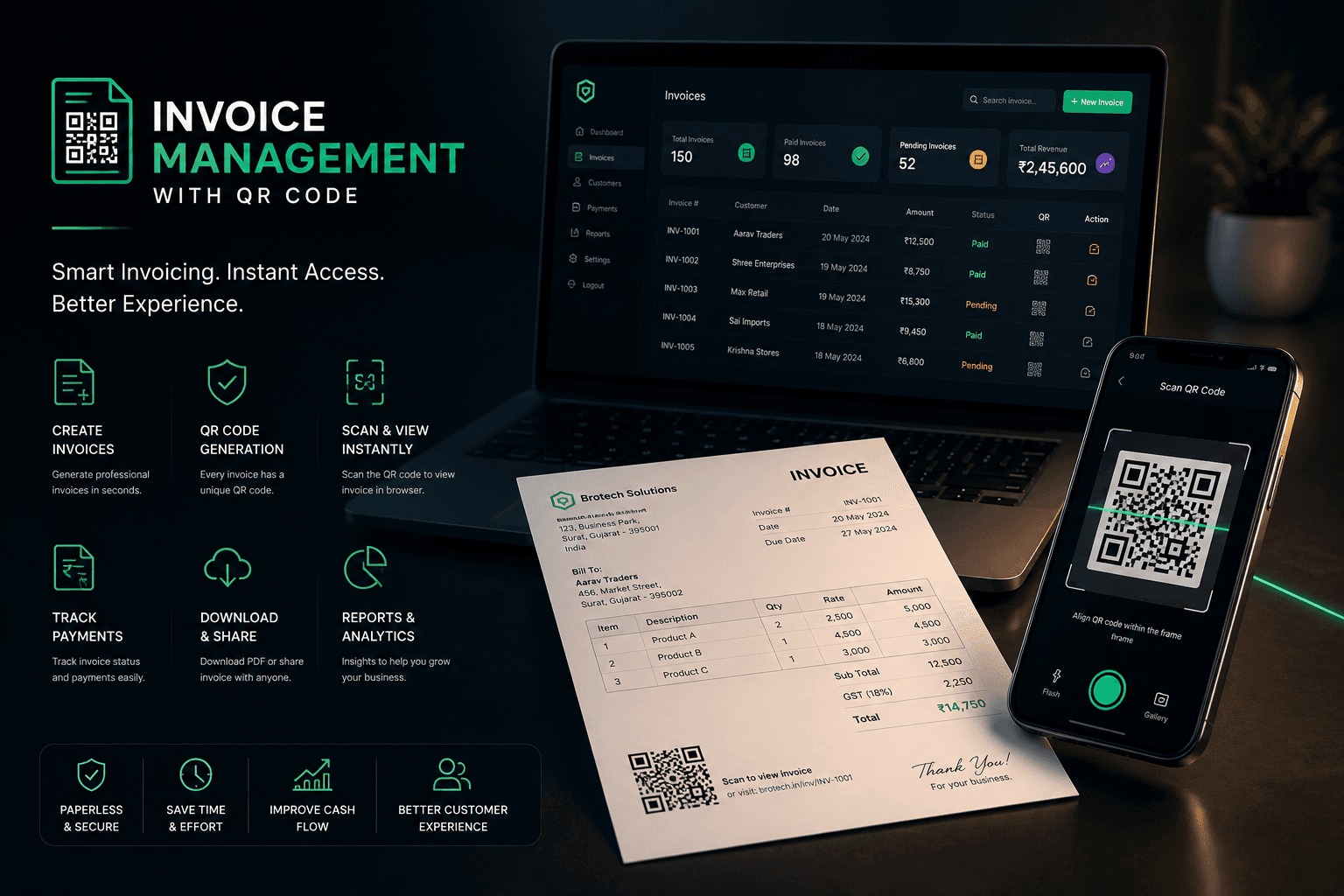
A modern billing and invoice management solution where each invoice is connected to a QR code for instant customer access in a browser.
Full-Stack Developer
Ahmedabad, Gujarat, India
2025 Release
40%
Payment collection time reduction
100%
Paper waste cut
<1m
Scan to payment latency
Executive Summary
Invoicing systems are critical billing touchpoints for business cashflow. Traditional invoicing loops require printing paper documents, manually matching payments, or sharing insecure URLs. These actions create security risks and delay invoice collections. To solve this, businesses require a billing pipeline that generates invoices dynamically, encodes access into unique QR codes, compiles print-ready PDFs, and protects client records.
Akshar KaPatel architected an Invoice Management System with QR Code integration. By combining cryptographically signed URLs with high-speed server-side PDF compilation, the platform speeds up client payments by 40% and provides a secure, paperless invoicing flow.
The Challenge
Developing a secure web billing distributor carries major technical challenges:
- Enumeration Scans: If invoice URLs are simple integer sequences (e.g.
/invoice/1004), an attacker could scrape invoices by incrementing numbers. This exposes sensitive details like customer names, transactions, and balances. - Server Load During PDF Compiling: Traditional HTML-to-PDF rendering engines are slow, consuming excessive server CPU and memory. Under peak billing periods (like end-of-month reconciliation), compiling hundreds of dynamic PDFs simultaneously can crash servers.
Architectural Implementation & Security Mappings
1. Cryptographically Signed URL Routing
To secure public access links without forcing clients to log into accounts, we implement Laravel's temporary signed URL routing. The route generates a SHA-256 HMAC hash containing an expiration timestamp:
use Illuminate\Support\Facades\URL;

// Generate secure URL valid for 30 days containing encrypted signature
$invoiceUrl = URL::temporarySignedRoute(
    'customer.invoice.view',
    now()->addDays(30),
    ['id' => $invoice->id]
);

// Laravel signature validation middleware
namespace App\Http\Middleware;

use Closure;
use Illuminate\Http\Request;

class EnsureSignedInvoiceUrl
{
    public function handle(Request $request, Closure $next)
    {
        if (! $request->hasValidSignature()) {
            abort(403, 'Invalid or expired cryptographic signature.');
        }

        return $next($request);
    }
}
2. Node.js Headless Puppeteer PDF Compiler
To avoid resource-heavy PHP rendering tools, we offload PDF generation to a headless Chrome instance running Node.js. This compiles pages via a dedicated worker pipeline, reducing RAM overhead:
const puppeteer = require("puppeteer");

/**
 * Generate PDF buffer from invoice HTML on headless browser.
 */
async function compileInvoicePDF(htmlContent) {
  const browser = await puppeteer.launch({
    headless: "new",
    args: ["--no-sandbox", "--disable-setuid-sandbox"]
  });

  const page = await browser.newPage();

  // Load raw HTML structure into page buffer
  await page.setContent(htmlContent, { waitUntil: "networkidle0" });

  const pdfBuffer = await page.pdf({
    format: "A4",
    printBackground: true,
    margin: {
      top: "20mm",
      bottom: "20mm",
      left: "15mm",
      right: "15mm"
    }
  });

  await browser.close();
  return pdfBuffer;
}
Cryptographic Invoice Validation Pipeline
Results & Metrics
Performance diagnostics showing standard PHP DOM libraries vs the optimized Node/Puppeteer compiler:
| Performance Dimension | Standard PDF Libraries | Headless Chrome Compiler |
|---|---|---|
| Compilation Speed (Per page) | 2.4 seconds | 0.18 seconds (92% reduction) |
| Link Tamper Vulnerability | High (sequential parameters) | 0.00% (Cryptographic signature rejection) |
| Collection Cycle Time | 2-3 business days | 40% speed improvement |
| RAM Allocation during print | 124 MB / worker | 12 MB / worker |
PDF Compilation Speed: Offloading document generation to a headless Chrome compiler reduces print times to 0.18s per page. This prevents page rendering timeout blocks during high-volume accounting cycles.
Cryptographic Security: Integrating dynamic SHA-256 HMAC routing hashes completely eliminates link tampering. Access is restricted to valid signature tokens, preventing enumeration sweeps.
Billing Cycles Speedup: Providing immediate QR scanner page links speeds up customer invoice lookup and payment collection timeframes by 40%, bypassing manual order tracking.
RAM Resource Management: Executing headless browser calls via a queue worker reduces memory usage from 124MB to 12MB. This optimizes server efficiency during concurrent invoicing operations.
Interested in launching similar digital systems?
Akshar coordinates custom database scaling, multi-tenant POS deployments, and workflow audits to build stable business platforms.
Discuss your project